


Autumn Abundance - A 10 Minute Daily Yoga Routine to Honor Summer & Build Consistency
The end of summer often arrives quietly. One week there are long evenings, bare feet, late dinners and open windows. The next, the light has softened, the air has changed, and the first signs of autumn are everywhere, I've already started seeing conkers on the ground in the park.
This shift can feel tender. Summer carries a certain fullness. It holds movement, warmth, plans, growth, travel, gardens, family time, outdoor meals and longer days. As autumn approaches, there is a natural invitation to pause and look back.
What grew this summer? What did you complete? What did you survive? What surprised you? What simple pleasures fed you?
Autumn is often seen as a season of letting go, and it is. But before release comes recognition. The harvest season reminds us to appreciate abundance before we move into quieter months. A short daily yoga practice can become a gentle way to mark that change, honor the body, and build steadiness from the inside out.
You do not need an hour, a perfect space or a complicated sequence. Ten minutes at home can be enough to create a real shift, especially when practiced regularly.

Autumn is a natural time to recognise abundance
Autumn asks for a different kind of attention. Spring often pulls us towards hope and fresh plans. Summer expands us outwards. Autumn draws us back towards reflection.
This does not have to be heavy or overly serious. It can be as simple as noticing what is already here.
A bowl of apples on the kitchen table. Herbs drying near a window. Photos from a trip. A stronger body after weeks of walking, swimming, gardening or moving more. A project finished. A hard conversation had. A boundary kept. A rest taken when it was needed.
Abundance is not only about having more. It is also about seeing clearly.
Sometimes the most meaningful achievements are quiet ones:
You stayed consistent with something that mattered.
You made space for rest, even once.
You cared for your home, body or relationships.
You learnt what you no longer want to carry.
You noticed joy in small, ordinary moments.
Yoga fits naturally into this seasonal pause because it brings awareness back to the body. Instead of rushing straight from summer busyness into autumn responsibilities, practice gives you a few minutes to breathe, listen and take stock.
A short practice is something that can become a daily ritual of gratitude. Not forced positivity. Not pretending everything has been easy. Just a steady moment to say, “This is what I have lived. This is what I have gathered. This is what I am ready to carry forward.”
Why daily practice matters......
A weekly yoga class can be wonderful. It gives structure, guidance, community and time to explore postures in more depth. But if yoga only happens once a week, the benefits may stay separate from daily life. The power of practice comes from repetition.
A short, regular practice teaches the body and mind that steadiness is available every day, not only when the diary allows. Ten minutes on a Tuesday morning can change how you move through the whole day. Ten minutes before bed can soften the nervous system before sleep. Ten minutes after work can help draw a line between what has happened and what comes next.
The aim is not to “be good at yoga”. The aim is to build a relationship with your own body.
When practice becomes regular, you start to notice more:
where tension gathers
how your breath changes with stress
which movements bring relief
when you are pushing too hard
what kind of rest you need
Once-a-week practice can feel like restarting each time. Daily practice, even brief practice, creates familiarity. The mat becomes less of an event and more of a place to return.
Consistency does not require intensity. It requires a small promise that you can keep.
This is where autumn can be helpful. The season already carries a rhythm of returning. Back to school, back to routine, back to warmer layers, soups, early nights and steadier days. A home yoga practice can sit inside that rhythm without demanding too much.
This Autumn Abundance A 10 Minute Daily Yoga Routine to Honor Summer and Build Consistency is not designed to exhaust you. It is designed to help you arrive. Give it a try.

A 10 to 15 minute home yoga routine for autumn abundance
This short sequence is gentle, grounding and easy to repeat. It can be practiced in the morning, after work or before bed. If you have an injury, are pregnant, or have a health condition, seek advice from a qualified professional before starting or changing movement practice.
You will need:
a yoga mat or comfortable floor space
a folded blanket or cushion
comfortable clothes
a quiet space if possible
Move slowly. Let the breath lead. Nothing should feel sharp or forced.
1. Arrive in stillness for 1 minute
Sit cross-legged, kneel, or sit on a chair with both feet on the floor. Rest your hands on your thighs or over your heart and belly.
Close your eyes if that feels comfortable. Notice the contact between your body and the ground beneath you.
Take five slow deep breaths.
With each exhale, let the shoulders drop a little. With each inhale, imagine creating space across the chest and ribs.
Silently ask yourself:
What am I grateful for from this summer?
What have I achieved, even quietly?
What do I want to carry into autumn?
Do not search too hard for answers. Let one simple word, image or feeling be enough.
2. Move through seated side bends for 1 minute
Stay seated. Place your right hand beside you and reach your left arm up and over. Breathe into the left side of the body. Come back to center and repeat on the other side.
Move gently from side to side.
This opens the ribs and waist, which can feel tight after travel, sitting, driving or busy summer days. It also invites a sense of spaciousness before the practice becomes more active.
Keep the hips heavy and the jaw soft.
3. Practice cat and cow for 2 minutes
Come onto hands and knees. Place wrists under shoulders and knees under hips. If your knees are sensitive, place a folded blanket underneath them.
As you inhale, lift the chest and tailbone. Let the belly soften slightly. As you exhale, round the spine, press the floor away and draw the chin gently towards the chest.
Move with the rhythm of your breath.
Cat and cow is simple, but powerful. It warms the spine, connects breath and movement, and helps you notice how your back feels today. Some days may feel fluid. Other days may feel stiff. Both are useful information.
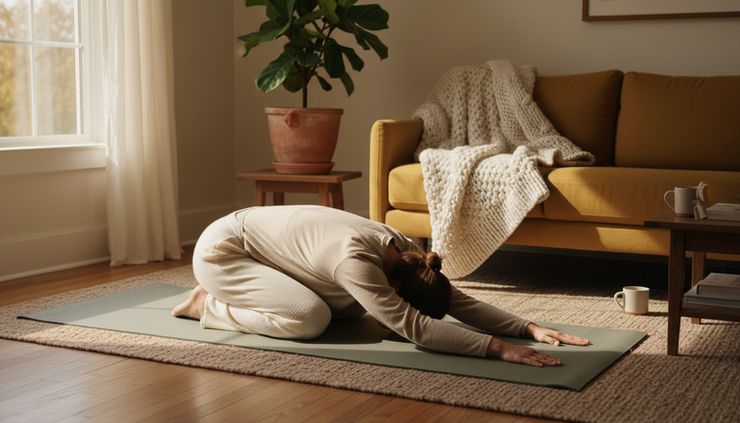
4. Rest in child’s pose for 1 minute
Bring your big toes together and knees apart, or keep the knees closer if that feels better. Lower the hips towards the heels and rest the forehead on the mat, a cushion or stacked hands.
Let the breath widen across the back body.
This is a good place to practice receiving support. The ground holds you. The breath moves without needing to be controlled. The body gets a moment to settle.
If child’s pose does not suit your knees or hips, rest on your back with knees bent and feet on the floor.
5. Flow between low lunge and half splits for 3 minutes
From hands and knees, step your right foot forward between your hands. Lower the back knee to the mat. Use blocks, books or fingertips on the floor for support.
Inhale and lift the chest into a low lunge. Feel the front of the left hip open.
Exhale and shift the hips back, straightening the front leg as much as feels comfortable. Flex the right foot and fold slightly over the leg for half splits.
Move between these two shapes for several breaths, then change sides.
This pairing is ideal for the change of season. The low lunge opens the front body and invites energy. Half splits turn attention inward and lengthen the back of the leg. Together, they create a balance of expansion and reflection.
Think of it as honouring both parts of autumn:
Opening to what is still growing
Celebrating summer’s fullness
Making space for what is ready to soften
Preparing for autumn’s steadier pace
6. Gentle downward-facing dog for 1 minute
From hands and knees, tuck the toes and lift the hips. Keep the knees bent if needed. Press evenly through the hands and lengthen the spine.
Pedal the feet slowly. Let one heel lower, then the other.
Downward-facing dog brings warmth into the body without needing to be intense. It can help you feel awake, present and connected from hands to feet.
If this posture feels too strong, choose puppy pose instead. Keep the hips over the knees, walk the hands forward, and lower the chest towards the mat.
7. Stand in mountain pose with breath for 1 minute
Step or walk slowly to standing. Place the feet hip-width apart. Let the arms rest by the sides.
Feel the soles of the feet. Notice the legs, pelvis, spine, shoulders, neck and head.
Inhale and sweep the arms overhead. Exhale and bring the hands to the heart. Repeat five times.
This simple movement can feel like gathering. You are gathering breath, attention and the energy of the practice. You are also standing in the results of the year so far, not rushing past them.
8. Close with legs resting or simple savasana for 2 to 4 minutes
Lie on your back. Bend the knees with feet on the floor, or extend the legs if that feels comfortable. You can also rest the calves on a sofa or chair.
Place one hand on the heart and one on the belly.
Let the breath become natural.
To close, silently name three things:
something you appreciate from summer
something you are proud of
something you are ready to release
Stay for as long as your time allows.
When you are ready, roll to one side and come up slowly. Try not to rush straight into your phone or to-do list. Let the practice settle for a few breaths.
How to make daily yoga feel realistic
A daily yoga routine only works if it fits real life. It has to survive busy mornings, darker evenings, family noise, low energy and days when motivation disappears.
Start smaller than you think you need to.
If 10 minutes feels easy, you are more likely to repeat it. If you demand 45 minutes and miss two days, the practice can start to feel like another thing you have failed to keep up with.
Try these simple anchors.
Link it to something you already do
Practice after brushing your teeth, before breakfast, after the school run, or before your evening shower. Existing habits make new habits easier to remember.
The question is not “When do I have free time?” Most people do not find spare time sitting around. Ask, “Where can 10 minutes naturally belong?”
Keep your mat visible
Mine lives on the living room floor 90% of the time then sometimes it's rolled up in the corner of the room. Because a rolled-up mat hidden in a cupboard is easy to forget. Leave it somewhere visible if you can. A corner of a bedroom, living room or hallway can become a small reminder.
You do not need a perfect yoga space. You need a space that is easy to return to. Part of my ritual for yoga is to light incense, you could do this or light a candle or play some soothing calming music for evening or something a bit more vibrant for a morning practice, hang drum music can be wonderfully refreshing for morning or evening.
Repeat the same sequence! Yessss!
Variety is enjoyable, but repetition builds consistency. When you repeat the same short routine, the body learns it. You waste less energy deciding what to do next.
Over time, the sequence becomes familiar enough to feel comforting. That familiarity is especially helpful during seasonal change.
Let the practice match your energy
Some days the routine may feel steady and strong. Other days it may be mostly breathing, cat and cow, and rest. That still counts.
Daily practice is not a performance. It is a check-in.
If you only have five minutes, do five minutes. If you feel tired, move slowly. If you feel restless, let the breath lengthen before asking the body to settle.

The deeper lesson of autumn practice
A regular practice teaches patience. It also teaches trust.
Summer often celebrates doing. Autumn invites digestion. Not only physical digestion, but emotional and mental digestion too. What happened this year? What has changed? What are you proud of? What needs to be composted into wisdom?
Yoga gives these questions a place to land in the body.
Through breath, movement and rest, you begin to notice that change does not have to be rushed. You can honor what has been abundant and still make room for less. You can appreciate achievement without clinging to constant productivity. You can let the season turn without feeling left behind.
The beauty of a short daily routine is that it meets you where you are. It does not ask for perfect flexibility, expensive equipment or a quiet life. It asks for presence, repeated gently.
As autumn approaches, let your practice become a small harvest ritual. Roll out the mat. Take ten minutes. Breathe with what you have gathered. Move with gratitude. Rest with trust.
The season is changing, and a steady practice can help you change with it.
I'd like to share this beautiful poem by Wendell Berry with you to close..... The poem reflects on the quiet observations of nature at summer's end, the permanence of memory, and the reassuring realization that "what we need is here".
The Wild Geese, Wendell Berry
Horseback on Sunday morning,
harvest over, we taste persimmon
and wild grape,
sharp sweet of summer's end.
In time's maze
over fall fields, we name names that went west from here,
names that rest on graves.
We open a persimmon seed to find the tree
that stands in promise, pale,
in the seed's marrow.
Geese appear high over us, pass, and the sky closes.
Abandon, as in love or sleep,
holds them to their way, clear,
in the ancient faith: what we need is here.
And we pray, not for new earth or heaven,
but to be quiet in heart, and in eye clear.
What we need is here.


Comments